Freeport is best known for being the home of L.L. Bean, one of the first stores to specialize in clothing and gear for outdoor enthusiasts. The town in very close to the coast, so we looked for a hiking opportunity in the area before we got into shopping mode.
We decided to visit Wolfe's Neck Woods State Park, a short 10-minute ride from downtown Freeport. We began our hike by strolling along the north shore of Casco Bay, where the tide was out. The stench from the decaying sea life and seaweed was very noticeable as we got closer to the bay. There were some men digging for clams in the muck. While watching them slave away, with their legs up to their knees in sticky mud, we determined that we will be happy to pay for those wonderful steamer clams than to dig them out ourselves.
With the tide so low, it appeared you could almost walk to Googins Island.
During the spring, this island is a haven for nesting Osprey. If you look closely, you can see two Osprey in the nest below.
The shoreline was extremely rocky around the bay. You can almost image the glaciers just pushing the rocks towards land when this region was formed over 25 million years ago.
The forest was very dense, but some blue sky was still evident when you looked upwards. We saw a mixture of different species of trees including evergreens, oaks and maples.
Part of the trail involved some uphill climbing. We had to step over lots of exposed tree roots, which were somewhat slippery from an overnight rain, along the path.
We observed several different wild flowers, including pink lady slippers
and trout lilies.
A visit to the Freeport area would not be complete without visiting L.L. Bean's flagship store. Paul is pictured outside next to the famous boot.
The marketing philosophy of the L.L. Bean brand is found in stone in the garden next to the store. Since their company has been successful for over 100 years, this philosophy appears to be working well. We wandered the store for quite a while and found a few items to purchase that we could use in our summer travels.
Some friends had told us to look for the scene of two moose in the L.L. Bean store window.
No animal is more symbolic of Maine's northern forests than the moose. In early spring 2006, Adella Johnson of New Sweden, Maine, found two moose carcasses with interlocked antlers frozen in a swamp. The moose had died of natural causes--their antlers had become locked together during a fight to show dominance and to possibly woo females the previous autumn. Unable to separate their antlers, the moose had eventually perished, likely of fatigue or starvation. L.L. Bean sponsored the project to depict what the scene might have looked like. Mark Dufresne, a Maine taxidermist, used real moose skulls and hide to create "The Final Charge". The display weighs approximately 1500 pounds.
Yes, the moose were huge, larger than those we saw in Wyoming the past three years, and looked ferocious in this fighting position.
For the last several weeks we have been observing a mother duck and her nine, yes nine, little ducklings wandering around the grassy areas of the campground. Finally we had the camera in hand when we spotted mother duck and her family wandering through a field. The ducklings were eating the very small insects buzzing around the tops of the grass.
Mama duck has the family no the move, crossing the entrance road as she heads the ducklings towards the 30-acre lake.
Not an easy pathway to the water, though. The ducks needed to go over the sand piled around the edge of the lake. The area where day visitors set up their chairs to enjoy sitting beside the lake is in the background.
Once the family reached the water, thehe mother duck led the family in formation along the shore. If you look closely, you can see just how clear the water is.
As the family moved further from the shoreline, the formation got tighter. Mama seems to be very much in control.
We think the ducklings are about 3-4 weeks old now. It will be interesting to watch the family "grow up" during the summer.
Wow, are we lucky! After a Memorial Day weekend filled with rain every day, we had sunshine on our first day off this week. We decided to celebrate seeing the sun by taking a short ride to Crescent Beach State Park along the Maine coastline for our first hike of the summer. The parking lot was huge, much larger than Siesta Key in Sarasota, but we were one of only about 10 cars - a bit too cool for the beach to be crowded. When we opened the car door, we could immediately smell the fresh salt air. It was during the work week and the temperature was in the low 60's but that didn't keep some Mainers from sun bathing on the beach.
These seagulls were playing in the surf. The sand was a light brown color, and this part of the beach was full of small stones as well as lots of seaweed.
We headed down the beach towards what appeared to be an island just off shore on the left below.
We soon came to a sign that said "No Trespassing" so we followed what turned out to be an old fire road and saw some beautiful spring flowers. There were plenty of Tall Goldenrods.
Also wild geraniums Unlike in Wyoming, the different types of wildflowers have been few and far between.
The forest was filled with lush greenery. This picture almost makes it appear we are hiking in a rain forest. These are cinnamon ferns and are growing wild everywhere on the forest floor.
Paul along the trail. While in this forest of mostly pines, there was a hint of the Christmas tree smell in the air.
We found one tree that didn't fare so well. This pine tree was overgrown by some type of suffocating vines. The only part of the tree still alive was the top few feet.
The path through the forest circled us back to our starting point, so this time we headed in the opposite direction towards Kettle Cove State Park. The terrain changed to a nice sandy beach with no stones. A few large clam shells littered the beach, but they had been picked clean by the seagulls.
We did find a small lobster tail that had washed up on the beach. This may look like it may be ready for boiling, but it was less than 2 inches long.
In addition to the temperature being in the 60's, there was a considerable breeze blowing in off the water. This was only the second day it was warm enough to wear shorts. Yes, Paul was wearing a light-weight vest to stay warm in the breeze.
At Kettle Cove, the point was very rocky, with layers of rock easily visible. My research on the Internet related that these rocks were formed over millions of years by a combination of movement of the earth's crust, as well as deposits from live volcano eruptions.
Paul standing on the point, balancing on the uneven rocks. There were several lobster boats in the cove, so we watched to see if there was any action on them.
While Ann was taking the photo above, two lobstermen drove up to the boat ramp to unload their small dinghy piled high with lobster traps.
The lobstermen unloaded the dinghy and headed out to their boat which was moored about 100 yards off-shore.
The lobster traps had to be off-loaded before they could go back to get the traps on the pick-up truck. The buoys are colorful so they are easy to spot while the lobsterman is checking his traps for lobsters. Each lobsterman has a unique colored design for his buoys.
After completing our beach hiking, we drove a few miles to see the Cape Elizabeth lighthouse. The shore is very rocky with the same type of "layered rock".
Because the lighthouse is up on a cliff about 75 feet above the water, the lighthouse itself is not very tall.
We turned to look out at Casco Bay, and we saw our lobstermen heading out to drop their traps. Notice how loaded the lobster boat is now with both sets of traps on board. Lobstering is one form of commercial fishing in Maine. However, lobstermen use a traditional lobster boat rather than a much larger commercial fishing boat.
We ended up with a hike of about 5 miles of walking in total. We enjoyed the sea breezes bringing in ocean aromas to make for a very pleasant outing.
We decided to visit the city of Portland on a cool, mostly cloudy afternoon in May. We explored the waterfront area and discovered that it is a working waterfront with lobster and fishing boats, a ferry terminal, and even several fire boats. The ferries travel to various islands off the coast, where we hope to ride our bikes once summer arrives. Yes, you can take bikes on the ferry boats. The waterfront area contains many restaurants as well, which we will explore at a later time.
We then headed to Old Port, the old section of town near the waterfront, to explore some of the many locally owned boutiques and shops. Ann seemed to say "I'll have to come back here when I have more time" on more than one occasion as we strolled from shop to shop. There seemed to be plenty of pubs or taverns among the shops as we wandered along the old and narrow cobblestone streets. What a fun way to build up a thirst and have an excuse to head toward Portland's local Shipyard Brewing Company.
We arrived just in time for the 3pm tour. Bear, our tour guide, ushered us into the Hops Chapel, where we sat on old church pews to watch an informational video about the beer brewing process. As you can
see below, the walls are lined with various bottles and awards the
brewery has earned over the years.
The video explained the brewing process established by Peter Austin, founder of the Ringwood Brewery in Hampshire, England. Peter came to the United States to be the mentor to Alan Pugsley, Shipyard's first master brewer. The beer making process the brewery uses today conforms to the traditional English ale brewing process - no lagers come from here.
We then went into the bottling facility to watch kegs and bottles being filled on two separate production lines. It was fascinating to see just how automated the bottling process is, from the bottles being rinsed, filled, capped, labels attached, put into 24-bottle cases and then the cases being put on a pallet and shrink wrapped for shipment--all done without human contact.
The final part of the tour was at the tasting bar. Bear, our guide, provided us with samples of eight of the 12 taps seen below, with a commentary on the taste of each beer served. The most unusual beer we sampled was Smashed Blueberry, a hybrid between a Porter and Scotch Ale. The beer was a dark brown with a purple hue, an aroma of blueberry and a blueberry syrup after-taste. Maybe it was the 9% alcohol that caught our taste buds by surprise. Drinking it was almost like sipping a strange wine. Other beer drinkers may love the stuff, but we enjoyed their standard brews much more.
Old Thumper is mounted in the Shipyard Brewary tasting bar as a tribute to Peter Austin. There is a statue of Old Thumper outside the Ringwood Brewery in England. Scroll up to refresh your memory. This stuffed head looks scraggly and the four paws being used as coat hooks makes it look like the man cave trophy of a bad hunting trip. Old Thumper is also the name of one of the Shipyard beers we tasted.
What a fantastic way to wrap-up a much needed day off after dealing with dogs and dog owners, handlers, etc. for four busy days.
Shipyard Brewing Company ships their product to 46 states including Florida and California. Shipyard also brews beer for other labels, including Sea Dog Brewing Company which has two restaurants in Florida. The first restaurant opened in the Clearwater area in February and the second just opened in the Lake Buena Vista area, near Walt Disney World. We have been to one of the Maine locations and can vouch for the quality of the beer and food.
Have a cold brew today and think of your friends, Paul and Ann, who sampled many of the Shipyard brews to ensure their high quality.
We arrived at our work location in Maine safely under cloudy skies. In fact, I don't think Paul wore sun glasses more than two days during the trip because of all the clouds and rain we encountered during the drive.
Wassamki Springs is a beautiful campground about 8 miles from Portland. We have a nice level campsite with pine trees, a picnic table and a fire ring--luxuries we didn't have each summer in Wyoming. It appears we made a great choice in destinations.
The focal point of the campground is a 30 acre lake formed while I-95 was being built in the late 1960's. Fill dirt/sand was needed for the road construction, so the contractor began digging on unused land behind the Hillock house on Saco Street. After many truckloads of fill were removed, the springs broke through the soil, and the lake was formed. Mr. Hillock decided to open a campground around the western shore of the lake in 1970; thus Wassamki Springs Campground became a reality.
Wassamki Springs CG is still owned by the Hillock family. The campground has over 500 sites with 155 available for rent on a daily, weekly, or monthly basis during the summer. The remainder are rented on a seasonal basis, with many local families vacationing here on weekends and a few weeks during the summer.
Once the weather gets nice enough for swimming, there will sometimes be up to 1000 non-campers who will pay a daily fee to use the beach, which goes about a mile around the lake. You can see some of the premium beach-side campsites in the photo below.
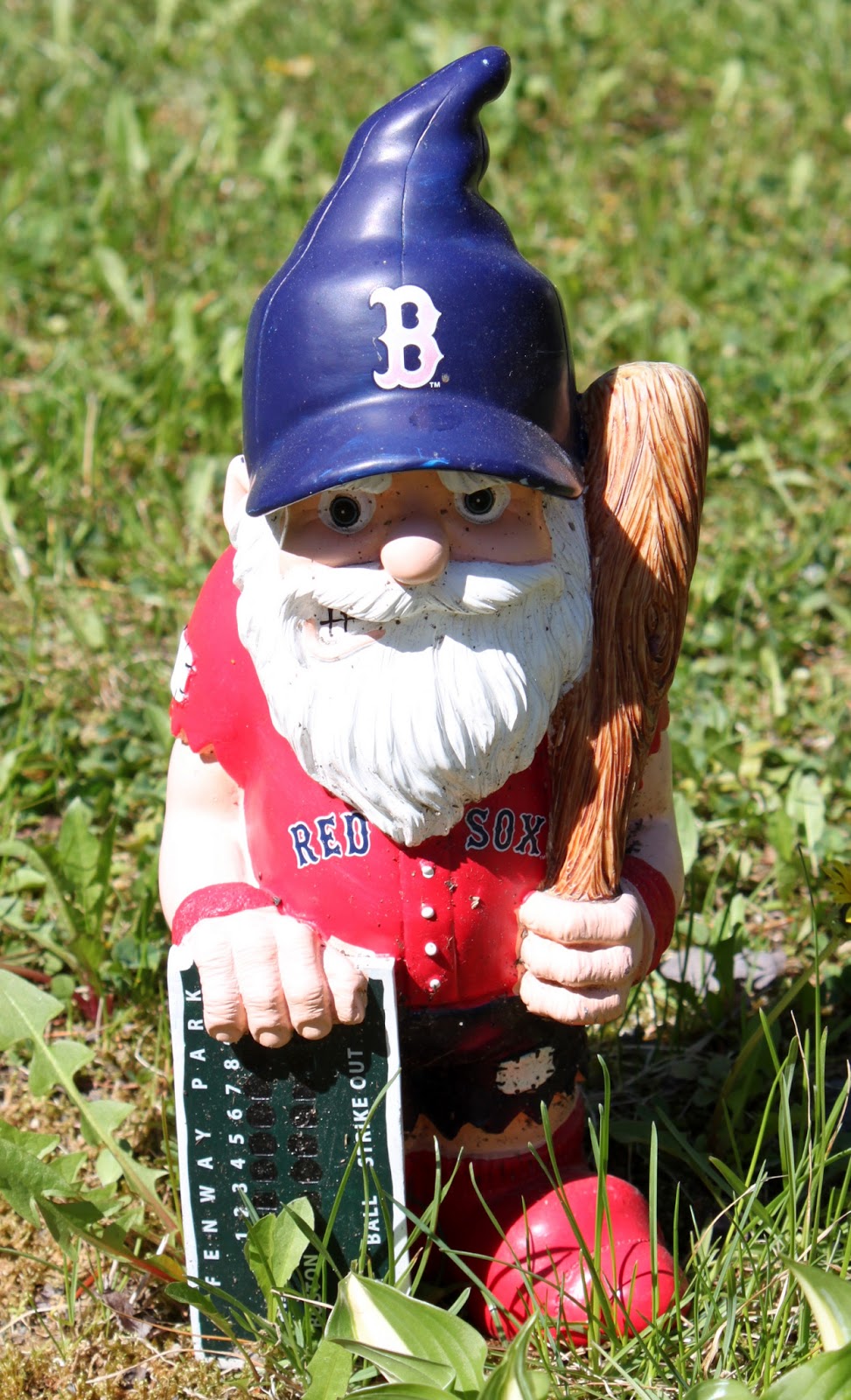
We are obviously in the heart of Red Sox Country, as seen by this gnome in a nearby campsite.Can you identify what the gnome is holding in his right hand?
We worked two days learning our jobs and doing general campground work.
Then came our first big event of the year; the Southern Maine Coastal Classic Dog Show, sponsored by the York County Kennel Club of Maine. Yes, our campground hosted over 3000 dogs for four days in May with as many as 900 dogs on one day. Some of the owners, handlers, and groomers who show their dogs camped here, while others streamed into the campground starting at dawn. Owners competed for prizes in the form of ribbons and points to qualify for future events, such as the Westminster Dog Show held in Madison Square Garden. Can you imagine what 900 barking dogs might sound like? How about LOUD, beginning at daylight, which is about 5:00 am?
There were two large tents, each nearly 150 feet long, erected on the campground's ball field. Our workday began at 6:30 a.m. Paul worked the general parking lot, where over 400 cars were parked each day of the show. Ann worked the front gate and had this view each day. The pup below is Loki, one of the show dogs, who obviously loves to ride in the car with his owner. Many of these show dogs are so pampered that they think they are people!
Next to the large tents were the eight show rings, which were actually squares with a one foot high picket fence around each perimeter. Both the men and women who were showing the dogs dressed up to show in the ring. The handler below was in a suit - to run a dog through his paces! Just part of the culture of the dog show. There was also a vendors' area, similar to a local fair, with every imaginable accessory for dogs being sold.
The grooming tent was full of tables, each with a collar for holding the dog in place attached to a 2 ft. high post fastened to the table. Grooming some breeds with long coats often took hours. Sometimes the dog was sprayed with water or even a chemical from a spray bottle and then blown dry with a hair dryer while the dog is being brushed. Where did the electricity come from to use a hair dryer? The participants carried small portable generators with them along with many other grooming accessories.
The judges inspected each dog's body for imperfections.
The winners of each breed's competition were awarded their ribbons on the awards stand.
And then there was the Best In Show, the culmination of each day's competition. The dog judged the best in each breed competed for a "best in group" award, with each breed belonging to one of seven groups (sporting, working, hound, etc.). The hound group is shown in the pictures below. It is hard to believe that all these dogs of various sizes belong to the same group.


The winner of each group then competed in the Best of Show, the culmination of each day's competition. The winner of this day's Best of Show was a Portuguese water dog, we think. During the competition, the judge merely pointed at the dogs in the ring to show ranking, and there were no formal announcements. We who do not understand the details of dog shows and the various breeds could only guess on the final outcome. But it was certainly interesting to watch the formality of each competition. One owner told Ann that showing dogs was like a gambling addiction. Having a dog that wins a competition makes the owner pursue more wins, almost at any cost.
It will definitely be nice to get back to regular campground work duties after the dog show people and their dogs leave.